Most founders know they should track runway.
Most founders know they should track burn rate.
Far fewer understand the difference.
Ask ten founders how much runway they have and you'll often get an answer based on outdated assumptions, spreadsheet estimates, or a vague understanding of monthly spending.
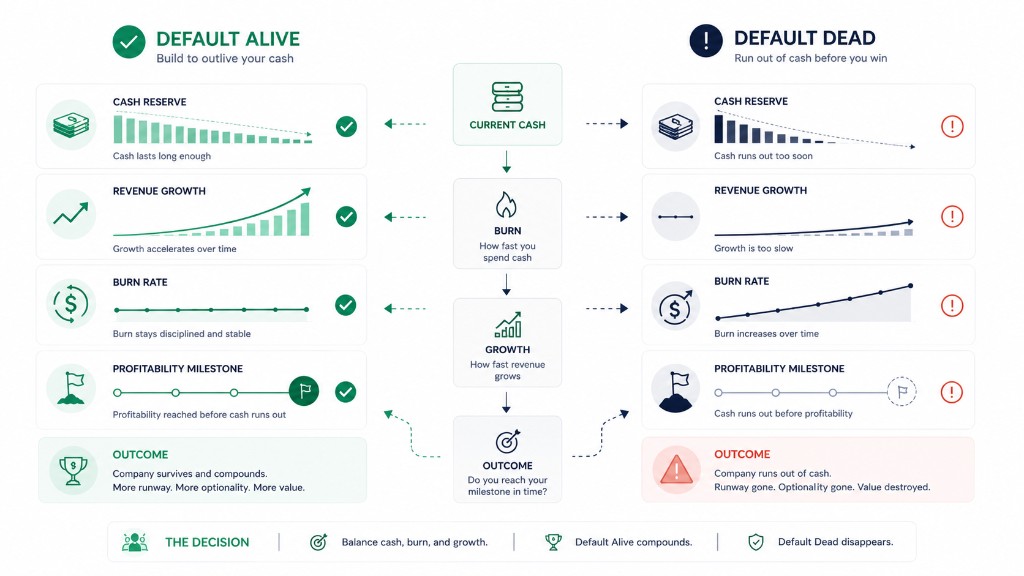
In 2026, investors care about more than just runway or burn rate. They increasingly focus on a third metric sitting behind both: burn multiple, and whether the company is default alive or default dead.
Understanding the relationship between runway, burn rate, net burn, gross burn, cash burn, and burn multiple has become essential for fundraising, financial planning, and startup survival. The same runway math breaks when ARR grows but cash does not; see ARR vs cash for why billing timing drives liquidity.
This guide breaks down:
- the vocabulary founders use interchangeably
- the 2026 benchmarks investors expect
- how to forecast runway accurately as your company scales
What Is the Difference Between Runway and Burn Rate?
The simplest explanation is:
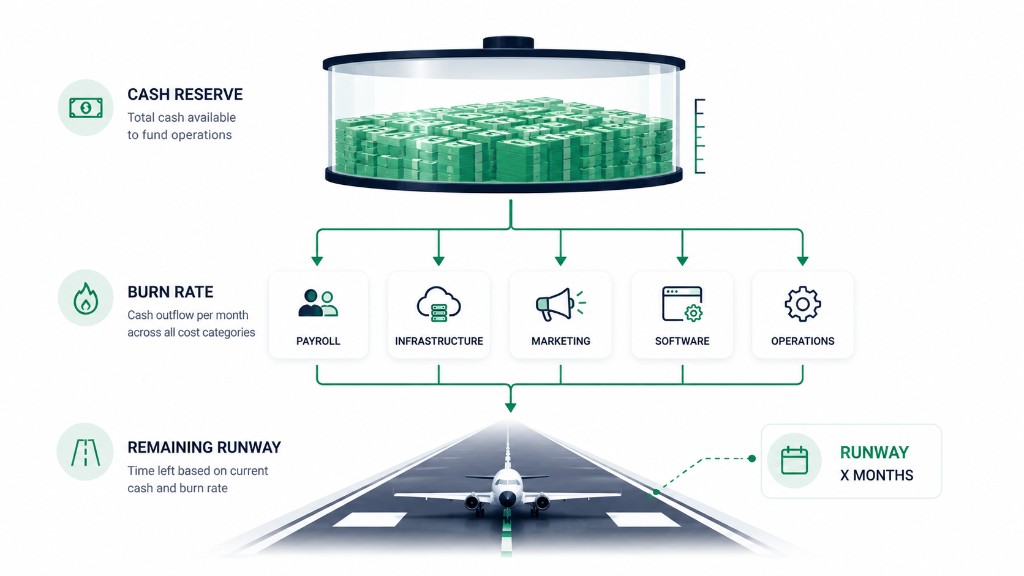
Burn rate is how fast you spend money.
Runway is how long you can survive at that spending rate.
Many founders use the terms interchangeably, but they measure completely different things.
Imagine a startup with:
- $1.2 million in the bank
- $100,000 monthly net burn
The burn rate is $100,000 per month.
The runway is 12 months.
One measures speed. The other measures time.
This distinction becomes important when investors ask:
- How much runway should a startup have?
- What is your current burn rate?
- How long can you operate without raising additional capital?
The answers require different calculations. Want a quick sanity check? Use the free startup runway calculator to model cash, revenue, and expenses in under a minute.
What Is Burn Rate?
Burn rate measures how much money a startup spends over a specific period.
Most founders discuss burn rate monthly.
However, there are actually multiple types of burn. This is where confusion begins.
Gross Burn Rate
Gross burn measures total monthly cash outflows.
Example:
- Payroll: $80,000
- Marketing: $10,000
- Software: $5,000
- Rent: $5,000
Gross burn = $100,000/month
Gross burn tells investors how much cash leaves the business. It does not account for revenue.
Net Burn Rate
Net burn is the metric most investors care about.
Formula:
Net Burn = Cash Outflows − Cash Inflows
Example:
- Monthly expenses: $100,000
- Monthly revenue: $40,000
Net burn = $60,000/month
This represents the amount of cash the company actually loses each month.
When founders ask how to calculate startup burn rate, they are usually referring to net burn.
Cash Burn vs Net Burn
Many founders use cash burn and net burn interchangeably. That is usually acceptable in casual conversation.
But during fundraising discussions, precision matters. Investors generally want to know:
- gross burn
- net burn
- cash balance
- runway
Each metric tells a different story.
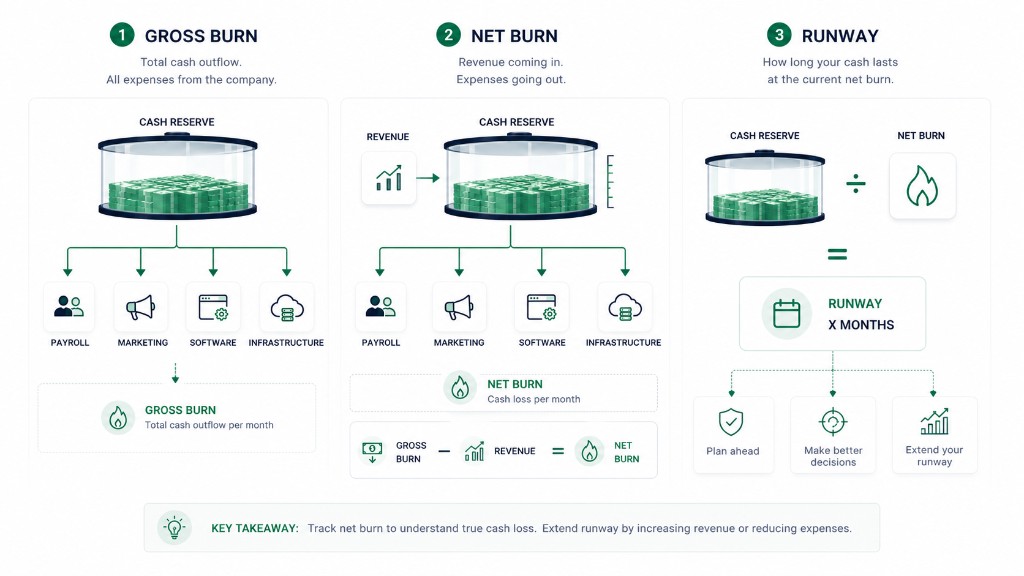
How Do You Calculate Startup Runway?
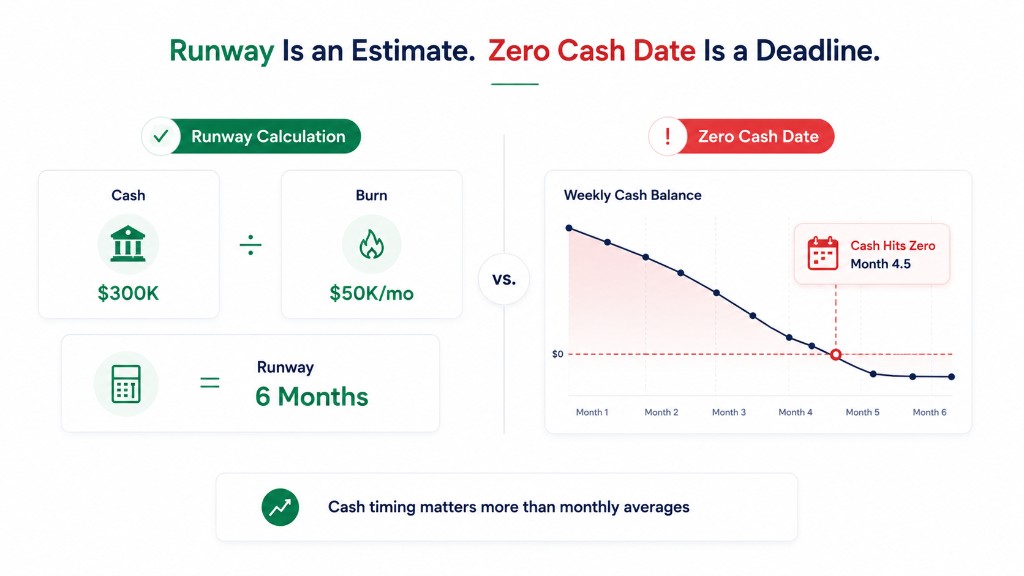
The classic startup runway calculation is simple.
Runway formula:
Runway = Cash on Hand ÷ Monthly Net Burn
Example:
- Cash balance: $2,000,000
- Net burn: $125,000/month
Runway = 16 months
This is the startup runway formula most founders learn first.
However, there is a problem. The formula assumes:
- revenue remains constant
- expenses remain constant
- hiring plans do not change
- customer churn remains stable
Real businesses rarely behave that way.
Why Spreadsheet Runway Calculations Are Usually Wrong
A startup may calculate 18 months of runway on the first day of the month.
Five days later:
- a new hire joins
- a major customer churns
- infrastructure costs increase
- AI compute expenses spike
The runway changes immediately. Static runway calculations become inaccurate surprisingly quickly.
This is why modern finance teams increasingly use rolling forecasts rather than static spreadsheets.
Instead of relying on cash balance divided by burn, they continuously update assumptions using:
- bank balances
- accounting data
- subscription revenue
- payroll expenses
- sales pipeline
This produces a much more accurate runway forecast.
How Zensus Helps
At Zensus, founders connect bank accounts via Plaid, accounting via QuickBooks, and subscription revenue via HubSpot into a single financial model. See how it works for the connect-to-forecast flow.
Instead of updating spreadsheets manually every month, runway updates automatically as actual data changes. Founders can drill from monthly to weekly to daily cash flow, run scenarios in plain English, and get Slack alerts when a 30-day projection crosses a cash floor they set.
That means founders always know:
- how much runway remains
- what changed
- which assumptions are driving the forecast
What Is a Burn Multiple?
If runway and burn rate were the most important startup metrics in 2021, burn multiple has become the metric investors increasingly watch in 2026.
Burn multiple was popularized by David Sacks as a way to measure capital efficiency.
Burn multiple formula:
Burn Multiple = Net Burn ÷ Net New ARR
Example:
- Net burn: $200,000/month
- Net new ARR created: $100,000
Burn multiple = 2x
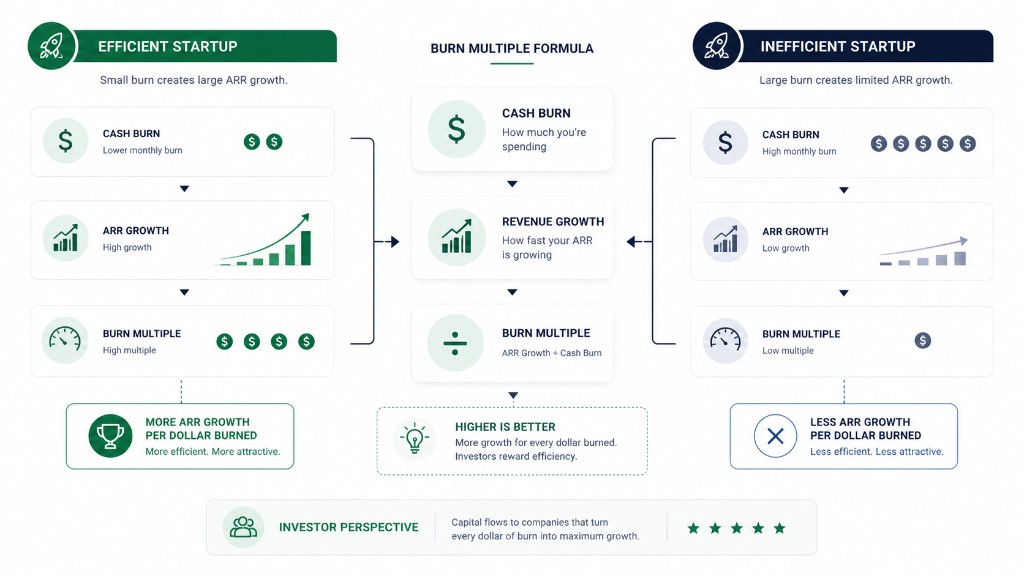
In plain English: for every dollar of new recurring revenue generated, the company spent two dollars.
This metric helps investors evaluate growth efficiency rather than growth alone. For the full 2026 context on runway targets and burn multiple thresholds, see our guide on 13-week cash flow forecasting.
What Is a Good Burn Multiple in 2026?
Investor expectations have changed dramatically.
- Burn multiple under 1x: exceptional
- Burn multiple between 1x and 2x: strong
- Burn multiple above 2x: potential concern
Many investors now treat a burn multiple below 2x as the minimum threshold for a capital-efficient startup.
This has become one of the most important startup fundraising metrics in 2026.
How Much Runway Should a Startup Have in 2026?
One of the most common questions founders ask today is how much runway investors expect in 2026.
The benchmark has shifted significantly.
- In 2021: typical runway target of 12–15 months
- In 2026: typical runway target of 18–24 months
Fundraising cycles are longer. Capital is more selective. Companies need more time to reach meaningful milestones before raising again.
Most investors now expect startups to maintain at least 18 months of runway after a funding round closes.
Payroll is often the largest driver of burn. For a step-by-step method to know whether payroll clears weeks ahead, see Will I Make Payroll?
Startup Runway Benchmarks by Stage
Typical burn by stage:
- Pre-seed: ~$100K per quarter
- Seed: ~$135K per quarter
- Series A+: ~$335K per quarter
These numbers vary by geography and industry, but they provide useful reference points for founders evaluating their own burn rate.
The goal is not minimizing burn. The goal is spending efficiently enough to reach the next milestone before cash runs out.
Want to start immediately? Download the free 13-week template, or get your zero-cash date in 60 seconds with the free runway calculator. For why monthly runway can hide your real cash out date, see zero cash date: calculate weekly, not monthly.