In October 2015, Paul Graham introduced one of the most useful concepts in startup finance.
The question was deceptively simple:
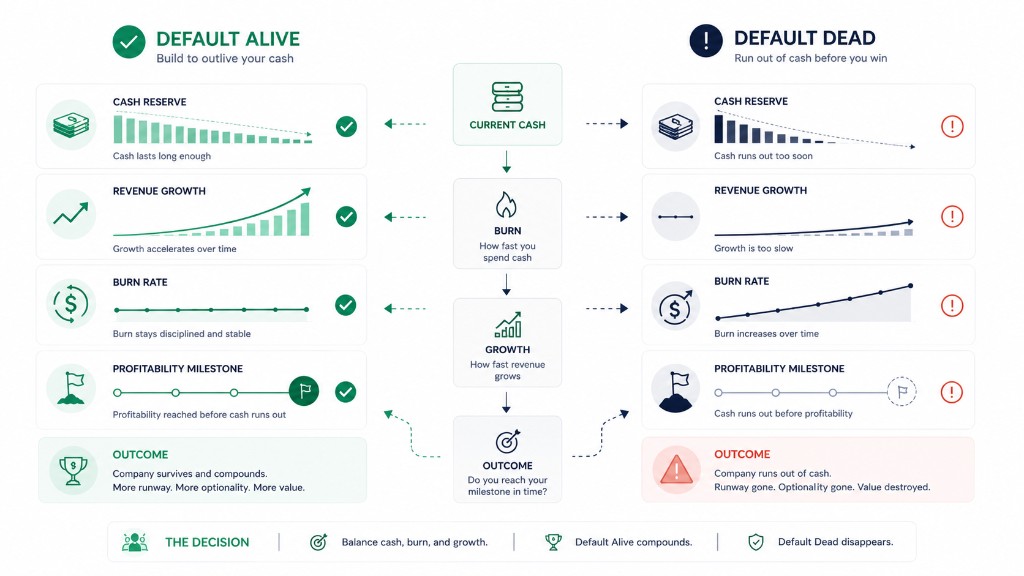
If you continue on your current trajectory and raise no additional money, will you reach profitability before you run out of cash?
If the answer is yes, you're default alive.
If the answer is no, you're default dead.
A decade later, the framework remains just as relevant, but the startup environment has changed dramatically.
In 2021, many startups could raise another round before profitability became urgent.
In 2026, investors increasingly expect founders to demonstrate capital efficiency, healthy startup runway, strong gross margins, and a realistic path to sustainability.
Today, default alive vs default dead is no longer just a theoretical exercise. It is one of the clearest indicators of startup fundability.
This guide breaks down:
- the four numbers that determine whether you're default alive in 2026
- the benchmarks investors quietly screen for
- what to do if you're currently default dead
What Does Default Alive Mean?
The original default alive definition remains unchanged:
A startup is default alive if it can reach profitability before running out of money without raising additional capital.
Importantly: default alive does not mean profitable today.
A company can still be losing money and be default alive. What matters is the trajectory.
If current growth, margins, and spending trends naturally lead to profitability before cash reaches zero, the company is default alive.
This is one reason founders often misunderstand the concept. They assume default alive means profitable. It doesn't. It means survival is possible without another fundraising event.
Paul Graham introduced the framework in his essay Default Alive or Default Dead. Who created the default alive framework? Paul Graham, in October 2015. Why is default alive important for startups? Because it answers whether the business can reach sustainability on its own, which is the core question behind startup survival metrics and fundraising readiness.
Am I Default Alive?
How to know if my startup is default alive: if you never raised another dollar, would current revenue growth and margin improvements eventually make the business profitable before your cash balance reaches zero?
If yes, you're likely default alive.
If no, you're likely default dead.
What Does Default Dead Mean?
What does default dead mean? A startup is default dead if current cash plus expected growth is insufficient to reach profitability before running out of money.
This does not necessarily mean the company is failing. Many successful startups have spent periods as default dead.
The distinction is that default dead companies require an external event to survive. Usually one of:
- a funding round
- venture debt
- a bridge round
- a major revenue acceleration
Without one of those events, the company eventually runs out of cash.
Can a Default Dead Startup Still Raise Money?
Can a default dead startup raise money? Absolutely. Many venture-backed startups are default dead.
The key difference is whether investors can see a credible path to becoming default alive.
What Is the Difference Between Default Alive and Default Dead?
What is the difference between default alive and default dead? Default alive means profitability arrives before cash runs out on the current path. Default dead means it doesn't, unless something external changes the trajectory.
One measures sustainability. The other measures dependency on the next capital event.
For the underlying math on runway and burn, see our guide on runway vs burn rate.
Why Investors Care More About This in 2026
One of the biggest changes in startup finance over the last few years has been investor expectations.
The era of growth at all costs has largely ended. Limited partners increasingly demand real returns. Venture firms pass that pressure to startups.
As a result, investors are now asking questions like:
- What is your startup burn multiple?
- How much startup runway remains?
- What are your startup gross margin benchmarks?
- How quickly can you reach startup profitability?
- Are you a capital efficient startup?
How investors evaluate startups in 2026 often comes down to these founder finance metrics, even when investors never say the phrase "default alive" out loud.
If a company is default dead with no realistic path to becoming default alive, the investment becomes significantly riskier.
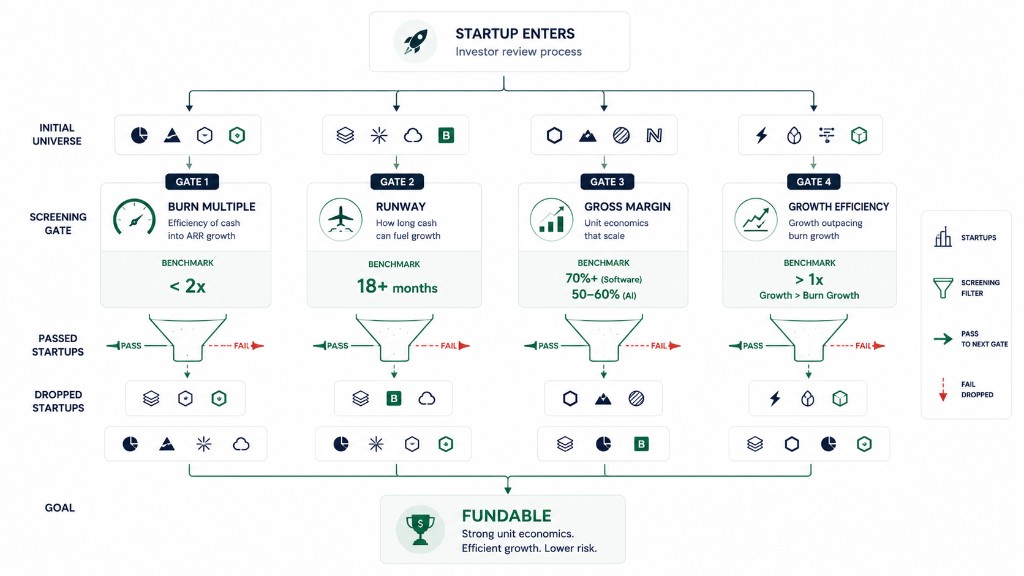
The Four Numbers That Determine Default Alive in 2026
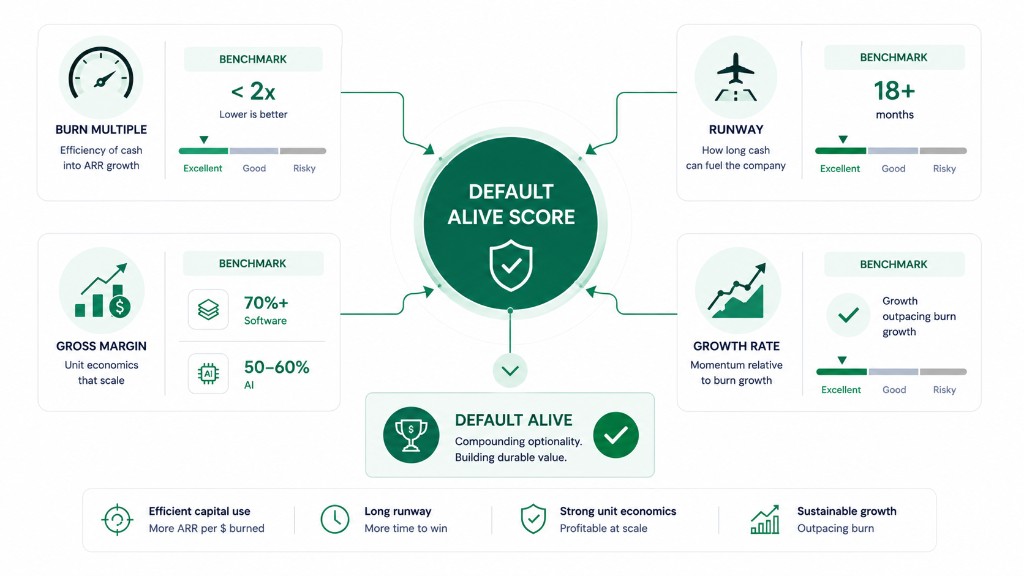
Paul Graham's original framework can now be translated into four practical metrics. Together they form a practical startup capital efficiency checklist and a workable default alive calculation.
1. Burn Multiple
Startup burn multiple has become one of the strongest indicators of startup capital efficiency.
Formula:
Burn Multiple = Net Burn ÷ Net New ARR
Example:
- Net burn: $200,000/month
- Net new ARR: $120,000/month
Burn multiple = 1.67x
What is a good burn multiple in 2026?
- Under 1x: exceptional
- Between 1x and 2x: strong
- Above 2x: potential concern
For many software startups, a burn multiple below 2x has become the modern startup fundability benchmarks 2026 threshold. For the full breakdown, see runway vs burn rate.
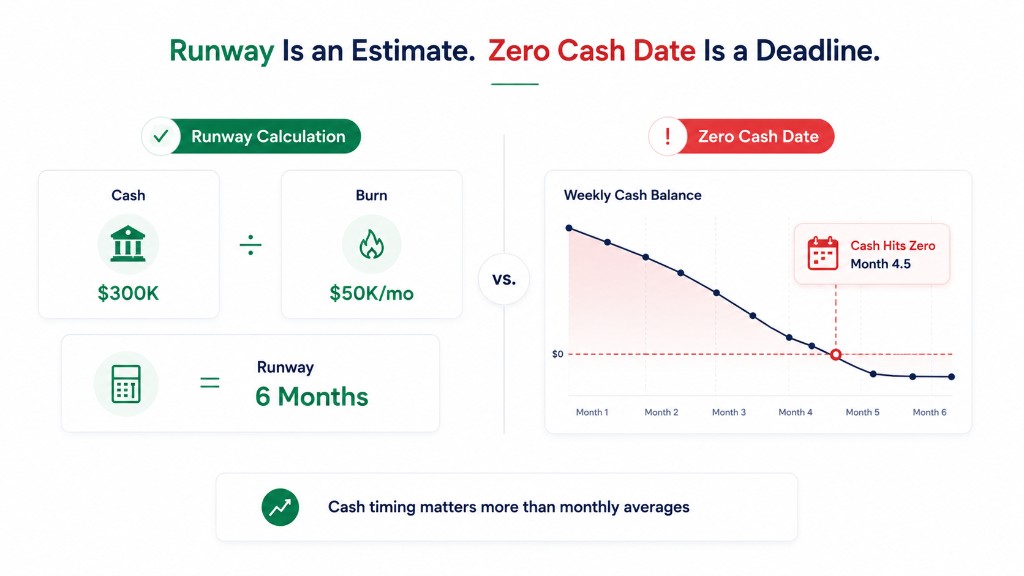
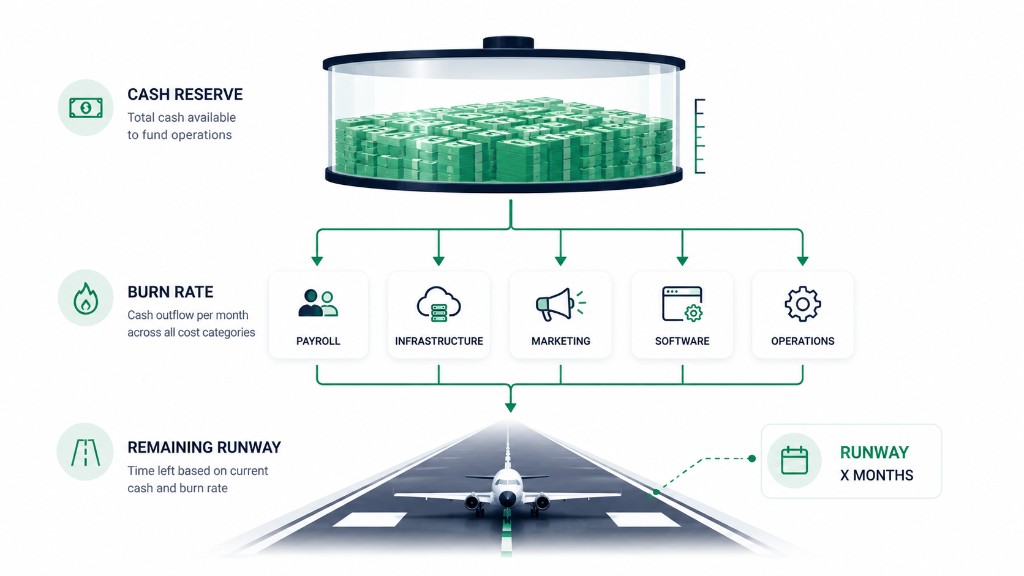
2. Runway
The second factor is startup runway.
Formula:
Runway = Cash on Hand ÷ Monthly Net Burn
Example:
- Cash balance: $1.8M
- Net burn: $100K/month
Runway = 18 months
How much runway should a startup have in 2026?
- In 2021: typical target of 12 to 15 months
- In 2026: typical startup runway benchmark of 18 to 24 months
Fundraising takes longer. Markets are more selective. Companies need more time to hit milestones.
Is 12 months of runway enough? Increasingly, no. Most investors prefer to see at least 18 months of runway after a financing event.
Model yours with the free startup runway calculator, or build a rolling view with our guide on 13-week cash flow forecasting.
3. Gross Margin
The third factor is startup gross margin and overall startup financial health.
Formula:
Gross Margin = Gross Profit ÷ Revenue
Software companies:
Healthy benchmark: 70%+ gross margin
AI-heavy companies:
Healthy benchmark: 50% to 60% gross margin
The difference exists because AI businesses often have meaningful inference and infrastructure costs. See forecasting AI compute costs for how variable compute spend affects margins and startup unit economics.
Can an AI startup be default alive with lower margins? Yes. Investors understand AI companies operate differently. However, lower margins mean the company must compensate through stronger growth or lower burn.
4. Growth Rate vs Burn Growth
The final factor is often ignored in a startup burn rate snapshot alone.
Revenue growth must outpace burn growth.
Company A:
- Revenue growing 12% monthly
- Burn growing 3% monthly
Likely moving toward default alive.
Company B:
- Revenue growing 6% monthly
- Burn growing 10% monthly
Likely moving toward default dead.
Growth alone is not enough. What matters is whether the business is becoming more sustainable over time.
Can a startup be growing and still be default dead? Absolutely. Many startups grow revenue while increasing expenses even faster. That creates growth without sustainability.
The Quick Default Alive Calculation
Most founders don't need a complex model to run a first-pass default alive calculation. Start with these three metrics:
Runway:
Cash on Hand ÷ Net Monthly Burn
Burn multiple:
Net Burn ÷ Net New ARR
Gross margin:
Gross Profit ÷ Revenue
Then ask:
If these trends continue, do we become profitable before runway reaches zero?
That is essentially the default alive calculation. A rolling startup profitability forecast inside your cash flow forecast answers the same question with real timing, not averages alone.
What To Do If You Are Default Dead
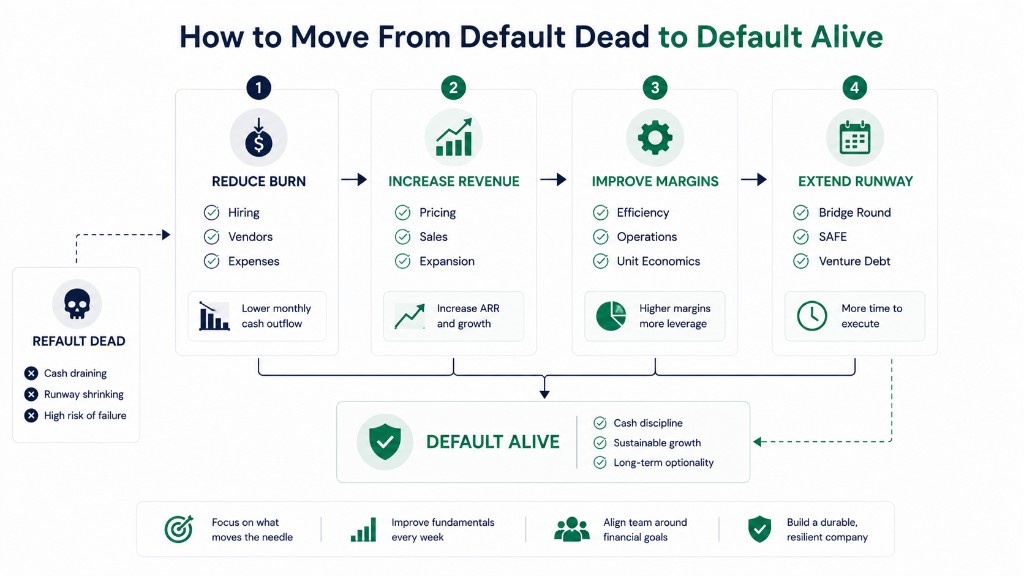
Discovering you're default dead isn't necessarily bad news. The important thing is acting early. This is the practical side of how to become default alive.
Reduce Burn
Focus on:
- delaying non-essential hires
- reducing contractor spend
- renegotiating vendor contracts
- eliminating low-ROI expenses
The goal is not cutting costs blindly. The goal is improving capital efficiency.
Accelerate Revenue
Many founders immediately focus on reducing burn. Often the better answer is increasing revenue.
Examples:
- improve conversion rates
- shorten sales cycles
- increase pricing
- improve expansion revenue
- launch high-impact features
Revenue growth can move a company toward default alive faster than cost cutting alone.
Explore Transitional Capital
Sometimes companies need more time. Options include bridge rounds, SAFE extensions, and venture debt.
The objective is not permanent dependency on fundraising. The objective is creating enough runway to become sustainably default alive.
Download the free 13-week template to stress-test how much time each option buys before your next milestone.
Why Investors Ask This Even When They Don't Say It
Investors rarely ask "Are you default alive?" directly.
Instead they ask:
- What's your burn multiple?
- What's your runway?
- What are your margins?
- How quickly are you growing?
They're asking the same question indirectly.
Only a small percentage of startups successfully raise the next round. Companies that can survive independently are dramatically less risky investments.
What makes a startup fundable in 2026?
- burn multiple below 2x
- 18+ months runway
- strong gross margins
- sustainable growth
- clear path to profitability
These are effectively the default alive metrics.
How Zensus Helps Founders Know
The biggest challenge is that default alive is not a static calculation.
Every new hire changes it. Every new customer changes it. Every pricing decision changes it.
This is why spreadsheet calculations become outdated quickly.
At Zensus, founders connect bank data via Plaid, accounting via QuickBooks, and subscription revenue via HubSpot into a single financial model. See how it works for the connect-to-forecast flow.
Founders can then answer questions such as:
- Are we default alive today?
- What happens if hiring accelerates?
- What if growth slows?
- How much runway remains under different scenarios?
Instead of debating assumptions, teams can run scenarios in plain English, drill from monthly to weekly to daily cash flow, and get Slack alerts when a 30-day projection crosses a cash floor they set.
Final Thoughts
Paul Graham's original framework remains one of the most useful startup finance concepts ever created.
The question is still the same:
Will you reach profitability before you run out of money?
The difference in 2026 is that founders can answer that question with four concrete numbers:
- burn multiple
- runway
- gross margin
- growth relative to burn
Together, these metrics determine whether your company is default alive or default dead.
Investors increasingly screen for them. Founders should too.