A 13-week cash flow forecast is the short-term liquidity model that has become the standard for finance teams who need to know whether they will make payroll next month.
Unlike annual budgets or high-level financial plans, a 13-week forecast focuses on one thing: cash moving in and out of the business every week.
For founders, this means understanding:
- whether payroll can be covered
- when large vendor payments are due
- how much runway remains
- whether hiring plans are realistic
- when fundraising conversations must begin
In today's venture environment, where capital efficiency matters more than growth at all costs, a rolling 13-week cash flow forecast is often more valuable than an annual operating plan. For the broader forecasting framework, see our guide on cash flow forecasting.
In this guide, we'll cover:
- what a 13-week cash flow forecast is and why teams use it
- rolling updates and cash flow forecast best practices
- how SaaS annual billing, quarterly billing, and deferred revenue change the math
- payroll forecasting, cash runway calculation, and burn rate forecast
- 2026 seed-stage SaaS runway benchmarks and scenario planning
What Is a 13-Week Cash Flow Forecast?
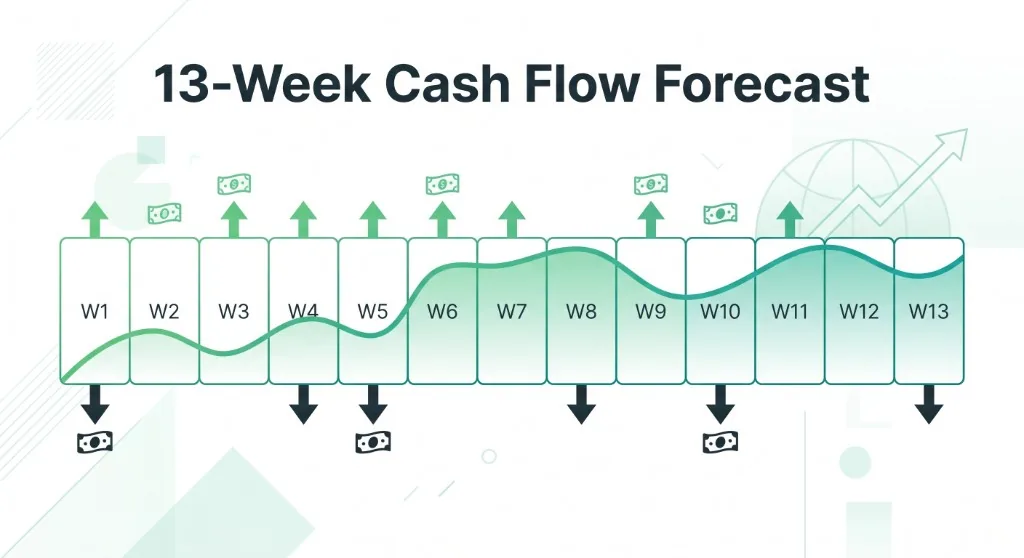
A 13-week cash flow forecast is a weekly projection of expected cash receipts and cash payments across the next fiscal quarter.
The model tracks:
Cash Inflows
- customer payments
- annual contract prepayments
- quarterly subscription renewals
- new sales collections
- financing proceeds
- tax refunds
Cash Outflows
- payroll
- contractor payments
- rent
- software subscriptions
- marketing spend
- taxes
- debt payments
The result is a week-by-week view of:
- operating cash balance
- expected ending cash
- cash runway
- potential liquidity risks
Unlike traditional FP&A reports, the model uses the direct method, meaning it forecasts actual receipts and payments rather than adjusting net income for accrual accounting items.
This is why CFOs, treasury teams, and increasingly startup founders rely on it for short-term decision making.
Why 13 Weeks Instead of 12 or 16?
The answer is surprisingly simple: 13 weeks equals one fiscal quarter.
That horizon is long enough to capture payroll cycles, customer payment cycles, accounts receivable collections, accounts payable obligations, and quarterly billing events, but short enough that direct cash forecasting remains reasonably accurate.
Beyond 13 weeks, forecasting starts depending heavily on assumptions rather than known transactions.
Most finance teams separate forecasting into:
| Forecast type | Horizon |
|---|---|
| 13-week cash flow forecast | Short-term liquidity |
| Quarterly forecast | Operational planning |
| Annual budget | Strategic planning |
| Multi-year model | Fundraising and valuation |
The 13-week horizon sits at the intersection of accuracy and usefulness.
Download the free 13-week template
A ready-to-use spreadsheet with weekly inflow and outflow lines, chained opening and closing balances, and a cash buffer check. Works in Excel, Google Sheets, and Numbers. No email required.
Download the XLSX templateThe Rolling 13-Week Forecast Model
A common mistake is treating the forecast as a one-time exercise. The most effective teams use a rolling 13-week cash flow forecast.
Every week:
- actual cash results replace forecasts
- the oldest week drops off
- a new future week gets added
The model always maintains visibility across the next 13 weeks.
Example
Week 1 ends. Instead of showing weeks 2–13 only, you update actuals and extend the model to weeks 2–14. A week later: weeks 3–15, and so on.
This rolling structure prevents visibility from decaying over time and improves forecasting accuracy because assumptions are continuously replaced with real data. Cash flow forecast best practices from leading finance operators consistently recommend updating the model weekly.
On Zensus, weekly and daily drill-down sit on top of a live cash flow forecast so founders can see whether this week's actuals match the 13-week plan without rebuilding a spreadsheet.
Why SaaS Companies Need a Different Approach
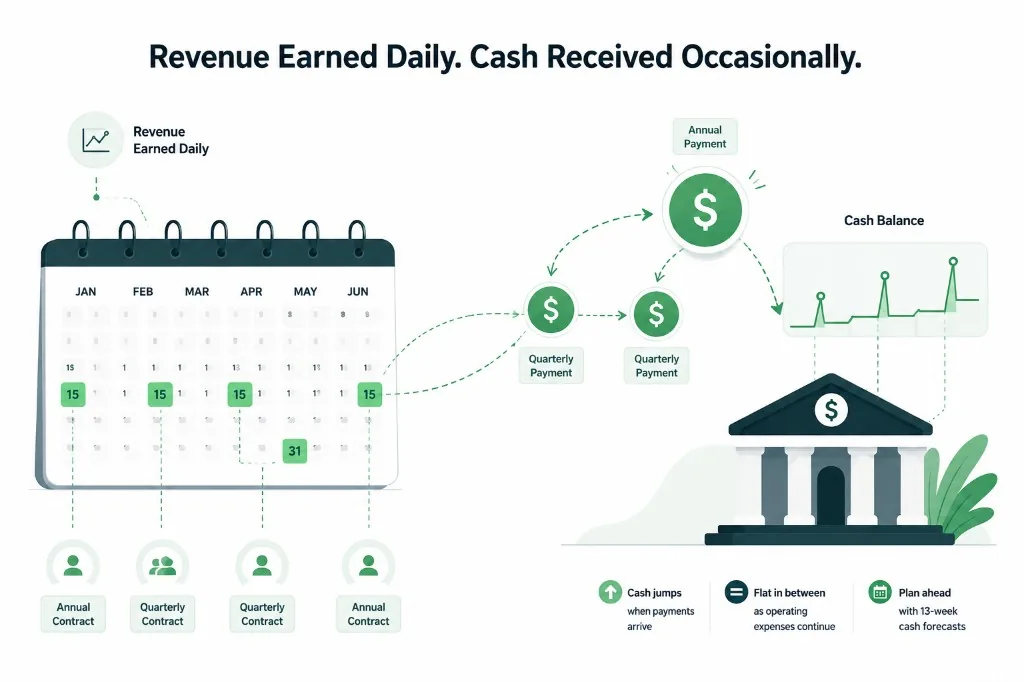
Most generic forecasting advice breaks down when you forecast cash flow for SaaS. The reason is billing cadence.
Annual Billing Creates Cash Spikes
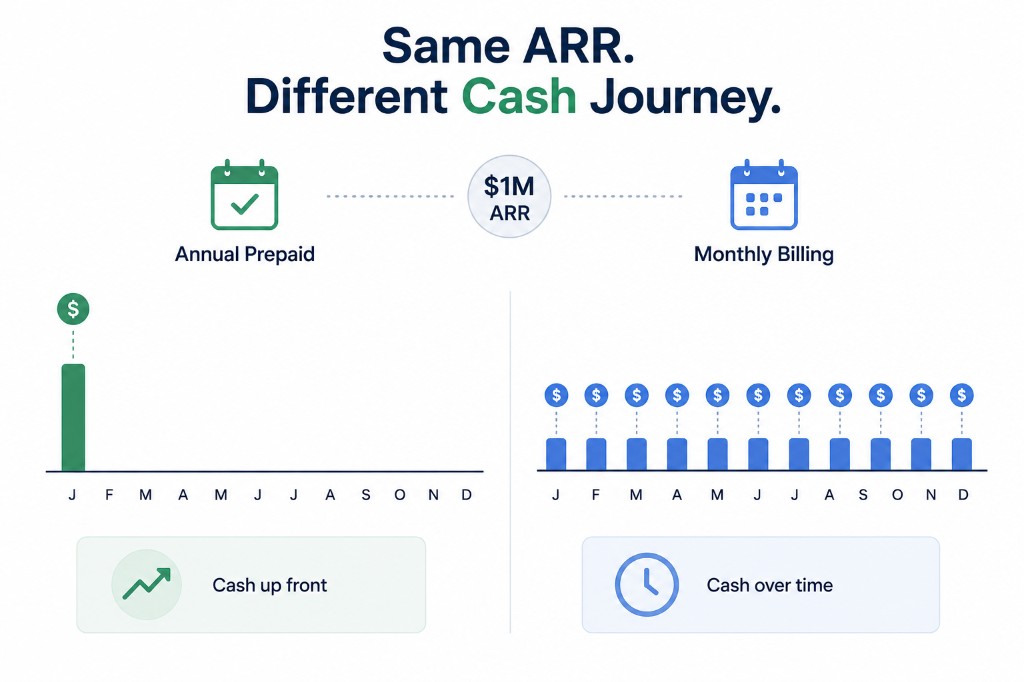
Suppose a customer signs a $24,000 annual contract. Accounting may recognize revenue at $2,000 per month, but cash arrives immediately as a $24,000 upfront payment.
A naïve forecast that follows revenue recognition instead of collections will dramatically understate available liquidity.
Quarterly Billing Creates Forecast Distortion
Quarterly billing creates another challenge: a customer paying $6,000 every quarter produces a predictable but uneven cash pattern. Forecasts built around monthly averages often miss these timing effects. When enough customers follow quarterly billing schedules, the distortion becomes material.
Deferred Revenue Is Not Cash
One of the most common SaaS mistakes is confusing deferred revenue with available liquidity. Deferred revenue represents obligations owed to customers; cash already collected sits in the bank. The accounting treatment and cash reality are different.
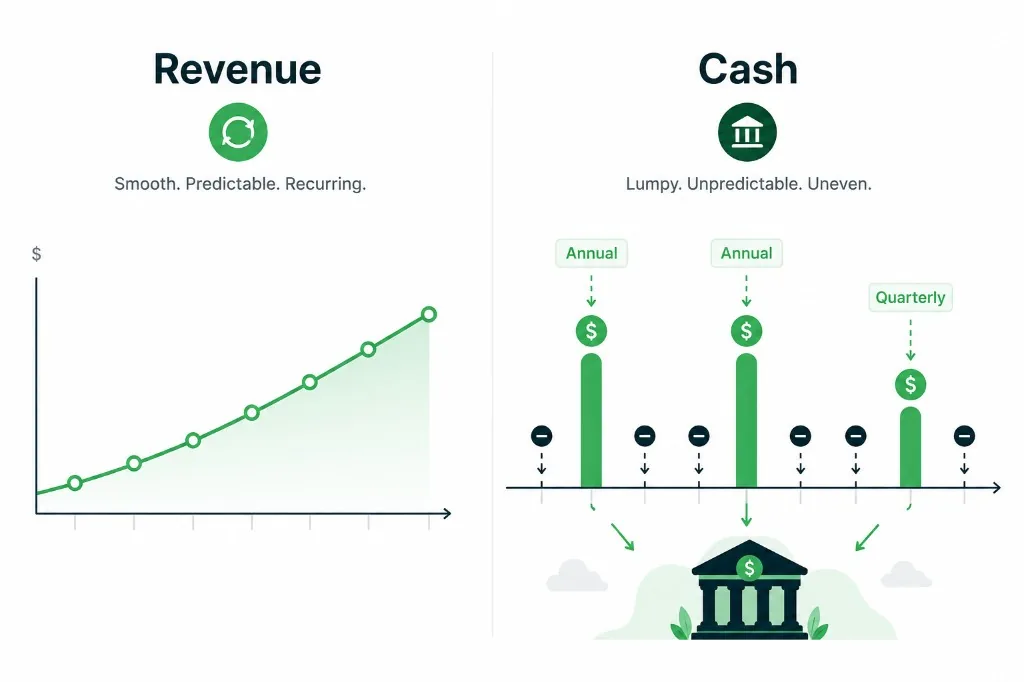
ARR Does Not Equal Cash Flow
This is where many founders get surprised. A company may report $1M ARR, strong growth, and healthy retention, yet still experience cash pressure.
Why ARR does not equal cash flow: ARR measures recurring revenue run rate; cash flow measures money actually arriving in the bank. Understanding SaaS ARR vs cash flow is essential when planning hiring, fundraising, and expansion. For a full walkthrough with contract examples and billing comparisons, see ARR vs Cash for founders.
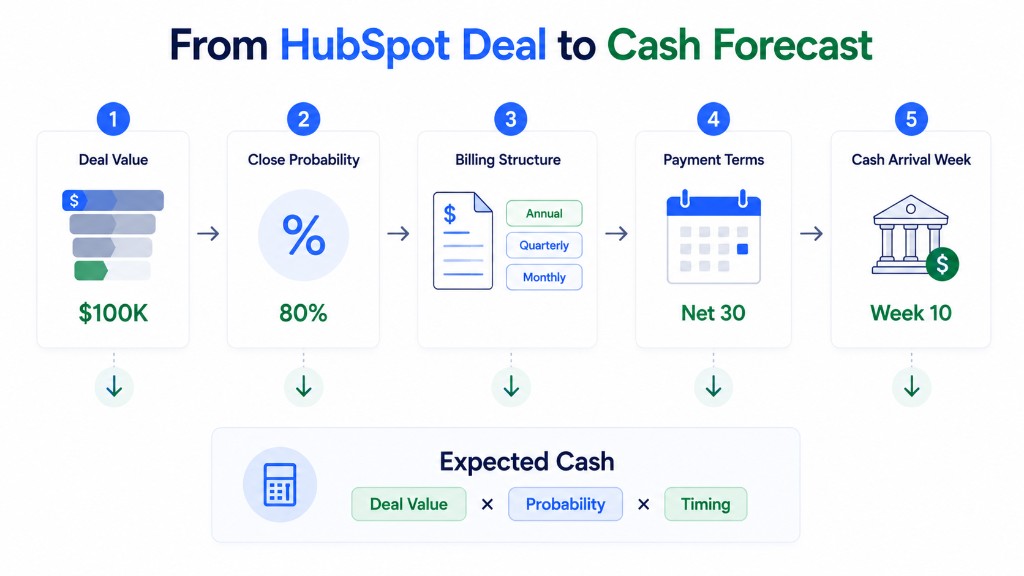
Zensus syncs HubSpot subscriptions, including annual and quarterly contracts, so your cash flow forecast reflects when cash hits the bank, not flat monthly revenue spreads. For open pipeline deals and Commit-stage timing, see HubSpot pipeline to cash forecast. See integrations for how each source feeds the model.
Payroll Forecasting: The Most Important Line Item
For most seed-stage SaaS companies, payroll forecasting represents the largest recurring expense. A strong 13-week cash flow forecast therefore begins with payroll.
Track:
- salaries
- founder compensation
- contractor payments
- benefits
- bonuses
- payroll taxes
Many startups underestimate payroll timing and only notice issues when operating cash balance becomes constrained. A weekly payroll forecast prevents these surprises and helps founders judge whether future hiring plans are financially realistic.
Cash Runway Calculation: What Founders Actually Care About
Every founder eventually asks: how many months of runway do we have left?
A simple cash runway calculation is (for the full vocabulary on gross burn, net burn, burn multiple, and 2026 benchmarks, see Runway vs Burn Rate):
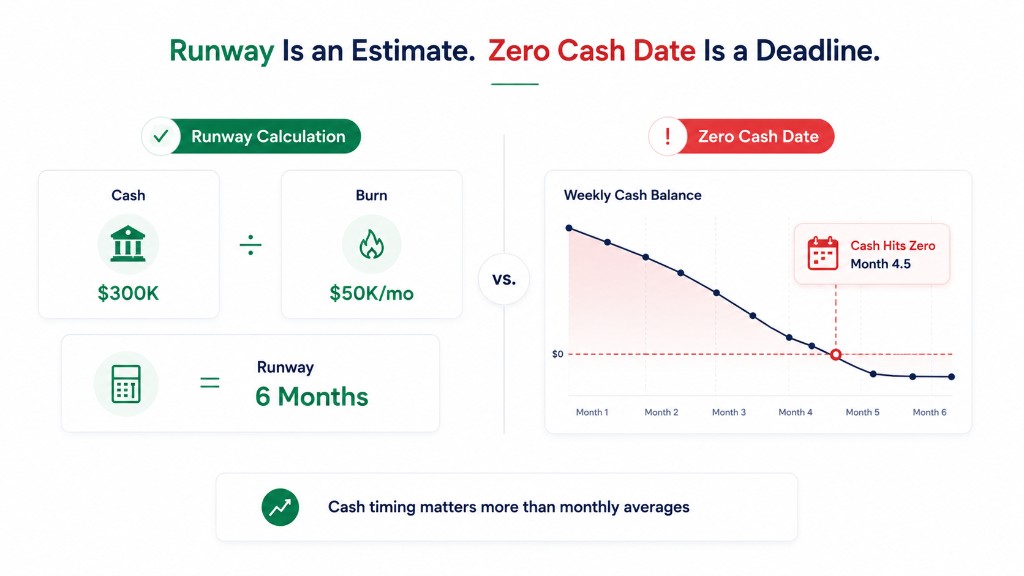
Runway = current cash ÷ monthly net burn
For example: $1.8M cash and $100k monthly burn implies 18 months of runway. However, this simplified formula ignores timing.
A detailed 13-week forecast shows when cash enters and leaves, seasonal fluctuations, large contract payments, and fundraising deadlines, producing a more accurate burn rate forecast than averages alone.
Zensus calculates zero-cash date and runway from connected bank and accounting data so the headline number stays tied to live balances, not a stale spreadsheet tab.
How Much Runway Can Annual Billing Add?
One of the highest-leverage decisions in SaaS is moving customers from monthly to annual billing.
Compare 100 customers at $100/month vs $1,200/year annual prepay:
- monthly billing: ~$10,000 cash collected per month
- annual billing: $120,000 cash collected upfront per cohort
Total ARR can remain identical while cash arrives much sooner. For many seed-stage SaaS startups, annual prepayment runway calculation shows that annual contracts can extend runway by several months without changing price or customer count. That is another reason investors push billing structure alongside growth.
Scenario Planning: Base Case, Upside, and Downside
No forecast is perfect. The goal is preparation, not prediction.
The most effective teams build a best case, base case, worst case cash flow forecast:
- Base case: expected outcomes from current information
- Upside: higher collections, stronger conversion, delayed hiring
- Downside: slower collections, churn, higher expenses
Leadership can ask what happens if reality diverges from expectations; the spread between scenarios often matters more than any single number.
13-week cash flow forecasting scenarios are faster to iterate when assumptions stack in one place: run scenarios with your cash flow agent on Zensus instead of copying three versions of the same spreadsheet.
2026 SaaS Runway Benchmarks
The venture environment has changed: investors prioritize durability over aggressive growth. Current venture capital guidance (2025–2026) increasingly emphasizes capital efficiency and runway discipline. Carta's State of Seed data shows the median time from seed to Series A now runs over two years, which is why runway guidance has stretched to 18 to 24 months.
Seed-Stage SaaS Startup Runway
Investors often expect:
- 18 to 24 months runway after funding
- controlled burn and clear milestones
- a credible path before the next round
SaaS Benchmark Runway
Typical SaaS benchmark runway targets in 2026:
- seed to Series A: roughly 18–22 months
- post-fundraise: 18+ months cash runway investors want to see
- a burn multiple below 2× where applicable, the threshold David Sacks defines as good for venture-stage SaaS
Fundraising timelines remain unpredictable. A reliable seed-stage SaaS startup runway 2026 view helps teams open conversations before liquidity becomes an emergency, not after.
Want to start immediately? Download the free 13-week template, or get your zero-cash date in 60 seconds with the free runway calculator. For a worked example of why weekly timing beats monthly averages, see zero cash date for founders.
Cash Flow Forecast Best Practices
The strongest forecasting systems share a few common characteristics.
1. Use Real Bank Data
Forecasts should start with actual cash balances. Bank integrations eliminate manual reconciliation errors.
2. Connect Accounting Systems
Accounting data provides bills, payroll obligations, accounts receivable, and historical trends.
3. Include CRM Pipeline Data
Future cash often originates from opportunities still in the sales pipeline. CRM visibility improves forecast accuracy.
4. Update Weekly
A rolling forecast only works if actuals continuously replace assumptions. Weekly updates should become a routine operating process.
5. Build Multiple Scenarios
Single-number forecasts create false confidence; scenario planning creates resilience.
Modern cash forecasting stacks combine bank data, accounting data, and CRM pipeline inputs into one model, the same pattern Zensus uses via Plaid, QuickBooks, and HubSpot. For what QuickBooks Cash Flow Planner covers on its own versus a dedicated planning layer, see Can QuickBooks Forecast Cash Flow? How it works walks through connect-to-forecast in under two minutes.
The Future of Cash Forecasting
Historically, finance teams built forecasts in spreadsheets: export bank data, reconcile accounting, update formulas, chase sales for pipeline updates.
Today, teams that combine bank data, accounting data, and CRM pipeline cash forecast workflows reduce manual effort and improve accuracy. The most effective systems treat liquidity planning as a live system, not a quarterly export.
That is the workflow Zensus is built for: subscription-aware projections, weekly drill-down, scenario planning, and Slack alerts when your 30-day projection crosses a threshold you set.
Final Thoughts
A 13-week cash flow forecast is not just another finance report. It is the operational heartbeat of a company.
For founders, it answers questions that matter immediately:
- Can we make payroll?
- How much runway do we have?
- Should we hire?
- When should fundraising start?
- How much risk exists in our current plan?
In 2026, where capital efficiency matters more than ever, the companies that understand cash tend to outperform those that only track revenue. A rolling 13-week forecast provides the visibility required to make those decisions with confidence.