The cash conversion cycle measures how long cash is tied up in a company's operating cycle before it comes back as cash collected from customers.
It combines three timing metrics: Days Inventory Outstanding (DIO), Days Sales Outstanding (DSO), and Days Payable Outstanding (DPO). The standard formula is:
Cash Conversion Cycle = DIO + DSO − DPO
For a startup, the important question is not simply whether the number is high or low. It is where cash is getting stuck.
If customers take 60 days to pay, inventory sits for 30 days, and suppliers give you 45 days to pay, your cash conversion cycle is 45 days. That means cash is effectively tied up in the operating cycle for about a month and a half.
For founders and finance teams, CCC turns a vague cash flow problem into three operational questions:
- How quickly are we turning inventory into sales?
- How quickly are customers paying us?
- How long can we wait before paying suppliers?
This guide explains how the cash conversion cycle works, how to calculate it, what a negative or positive CCC means, and how to use it alongside a cash flow forecast.
What is the cash conversion cycle?
The cash conversion cycle is the number of days between paying cash for operating inputs and collecting cash from customers.
The metric is also called the cash cycle or net operating cycle. It focuses on how long working capital remains tied up in the business.
The standard formula is:
CCC = DIO + DSO − DPO
Where:
- Days Inventory Outstanding (DIO): how long inventory sits before it is sold
- Days Sales Outstanding (DSO): how long customers take to pay after a sale
- Days Payable Outstanding (DPO): how long you take to pay suppliers
Oracle's financial analytics documentation uses the same basic cash cycle structure, combining days sales outstanding, inventory days, and days payable outstanding.
The idea is simple:
- Buy inventory
- Hold inventory
- Sell product
- Invoice customer
- Collect cash
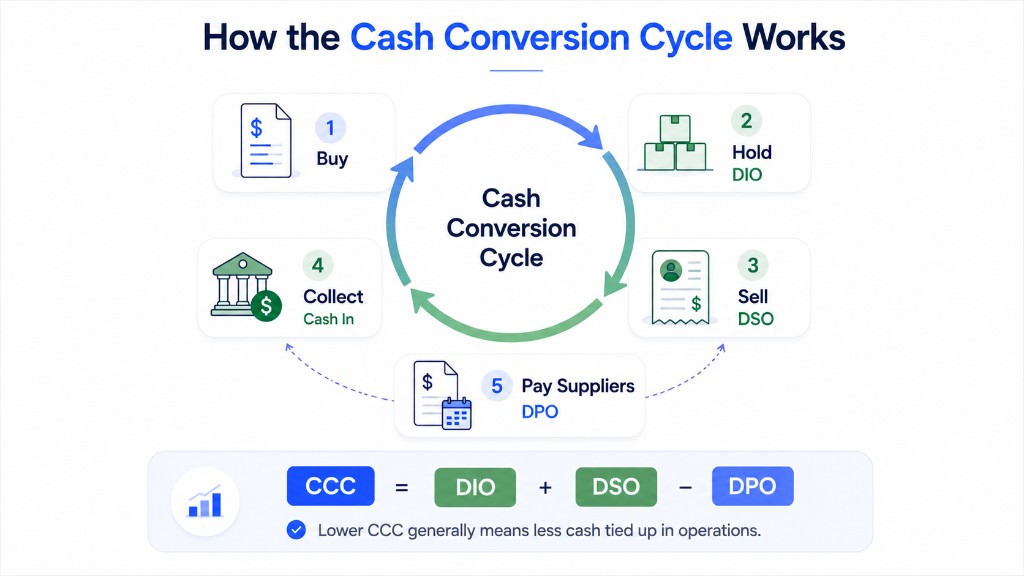
Supplier payment timing sits underneath this process.
If you pay suppliers before you collect from customers, cash is tied up. If customers pay you before you need to pay suppliers, the business can operate with less working capital.
Why does the cash conversion cycle matter for startups?
A longer cash conversion cycle generally means more cash is tied up in operations before it returns to the bank.
That matters because a growing company can consume cash even when revenue and gross profit are increasing.
Consider a company growing quickly. It needs to:
- Buy more inventory
- Hire more people
- Pay more vendors
- Extend more customer payment terms
- Carry more accounts receivable
Revenue may look excellent. The bank balance can still fall.
This is particularly important for startups that are scaling faster than their cash collections. A company that grows from $500,000 to $2 million in annual sales may need substantially more working capital if customers pay slowly and suppliers require payment quickly.
The cash conversion cycle helps explain why. For how ARR can grow while cash stays flat, see ARR vs cash for founders.
How do you calculate the cash conversion cycle?
Start with the three components.
1. Calculate Days Inventory Outstanding
Days Inventory Outstanding measures how long inventory remains in the business before it is sold.
A common formula is:
DIO = Average Inventory ÷ Cost of Goods Sold × Number of Days
For example, assume:
- Average Inventory = $100,000
- Annual COGS = $730,000
- Days = 365
Then:
DIO = $100,000 ÷ $730,000 × 365 = 50 days
The company is carrying roughly 50 days of inventory.
For a SaaS company with no meaningful physical inventory, DIO may be close to irrelevant. For an ecommerce, hardware, manufacturing, or retail company, it can be one of the biggest drivers of working capital.
2. Calculate Days Sales Outstanding
Days Sales Outstanding measures how long it takes a company to collect money after making a credit sale.
A common formula is:
DSO = Average Accounts Receivable ÷ Credit Sales × Number of Days
For example:
- Average Accounts Receivable = $120,000
- Annual Credit Sales = $1,095,000
- Days = 365
Then:
DSO = $120,000 ÷ $1,095,000 × 365 = 40 days
The company collects its receivables in about 40 days on average.
DSO is especially important for B2B startups because a sale does not become cash when the contract is signed. It becomes cash when the customer pays.
3. Calculate Days Payable Outstanding
Days Payable Outstanding measures how long a company takes to pay its suppliers.
A common formula is:
DPO = Average Accounts Payable ÷ Cost of Goods Sold × Number of Days
For example:
- Average Accounts Payable = $90,000
- Annual COGS = $730,000
- Days = 365
Then:
DPO = $90,000 ÷ $730,000 × 365 = 45 days
The company takes about 45 days to pay suppliers.
4. Put the three numbers together
Now calculate CCC:
CCC = DIO + DSO − DPO = 50 + 40 − 45 = 45 days
The business has a 45-day cash conversion cycle.
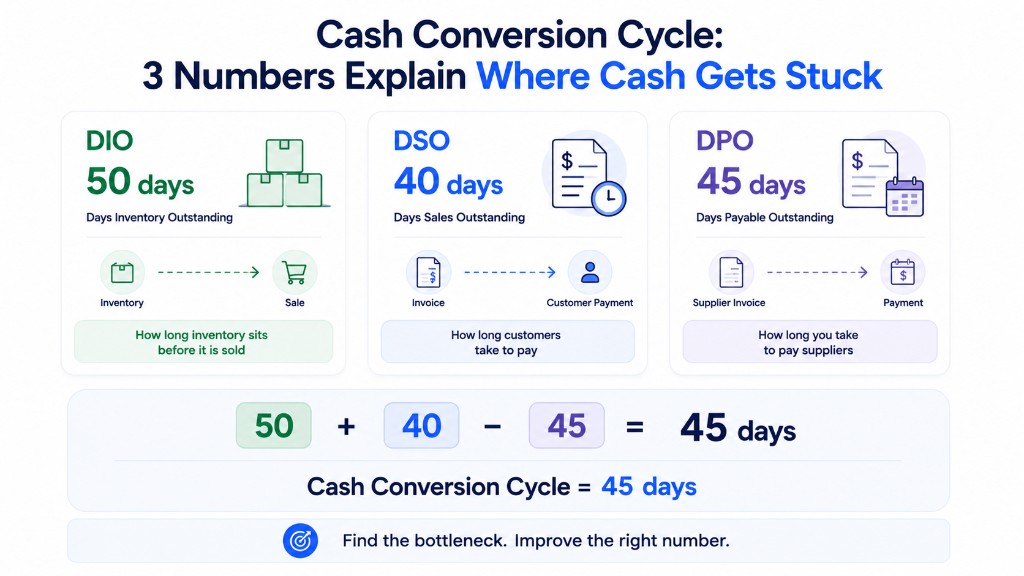
The calculations above are illustrative examples. The formula and metric structure are documented in Oracle's General Ledger analytics metrics.
What does a 45-day cash conversion cycle mean?
A 45-day CCC means the business has, on average, about 45 days of cash tied up between paying for operating inputs and collecting customer cash.
Think of it as a funding gap.
The company:
- pays suppliers
- holds inventory
- makes sales
- waits for customers to pay
During that period, the company has to fund the gap from somewhere.
That funding can come from:
- existing cash
- supplier credit
- customer prepayments
- working capital facilities
- equity financing
- debt
This is why CCC matters to cash planning. A lower CCC generally reduces the amount of working capital the company needs to support a given level of operations.
What is the difference between CCC, DIO, DSO, and DPO?
These metrics describe different parts of the same cash cycle.
| Metric | What it measures | Founder question |
|---|---|---|
| DIO | Time inventory is held | How quickly are we selling what we bought? |
| DSO | Time to collect receivables | How quickly are customers paying? |
| DPO | Time to pay suppliers | How long do we retain cash before paying vendors? |
The key is not to look at CCC alone. A 45-day CCC can come from very different operating models.
For example:
- DIO = 50, DSO = 40, DPO = 45 → CCC = 45 days
- DIO = 10, DSO = 80, DPO = 45 → CCC = 45 days
The headline number is identical. The operating problem is completely different.
The first company has an inventory problem. The second has a collections problem.
Is a lower cash conversion cycle always better?
Generally, a shorter CCC means less cash is tied up in the operating cycle, but the right target depends on the business model.
A company should not reduce CCC at any cost.
Pushing suppliers to accept extremely short payment terms could reduce DPO and make cash flow worse. Offering customers aggressive early-payment discounts could reduce DSO while hurting gross margin.
The objective is not to make every metric as small or large as possible. The objective is to improve the economics and timing of the entire operating cycle.
What does a negative cash conversion cycle mean?
A negative cash conversion cycle means a company collects cash from customers before it has to pay its suppliers.
For example:
- DIO = 20 days
- DSO = 5 days
- DPO = 40 days
CCC = 20 + 5 − 40 = −15 days
In this example, the operating cycle is negative 15 days. The company is effectively collecting customer cash before its supplier payments are due.
That can be a powerful business model advantage.
It is common to see this structure in businesses where:
- customers pay upfront
- inventory turns quickly
- suppliers offer extended terms
But negative working capital is not automatically healthy. A company can also have negative working capital because it is struggling to pay bills or because its obligations have changed.
The number needs to be interpreted alongside cash flow and the underlying business model.
How can you improve the cash conversion cycle?
There are three main levers.
Improve DIO
If inventory is sitting too long, you can:
- Reduce slow-moving stock
- Improve demand forecasting
- Order smaller quantities more frequently
- Remove low-performing products
- Improve inventory turnover
The goal is to turn inventory into sales without carrying unnecessary stock.
Improve DSO
If customers are paying slowly, you can:
- Invoice immediately
- Make payment terms explicit
- Automate payment reminders
- Offer convenient payment methods
- Review customers with repeated late payments
- Negotiate shorter payment terms for new contracts
For many B2B companies, DSO is the most directly controllable part of CCC. A customer paying on day 30 instead of day 60 can materially change the company's cash position.
Improve DPO
If suppliers are being paid too quickly, you can:
- Negotiate longer payment terms
- Align payment dates with customer collections
- Consolidate vendor payments
- Avoid paying invoices significantly before they are due
The goal is not to pay suppliers late. It is to avoid giving up cash earlier than necessary.
Can a growing startup have a good CCC and still run out of cash?
Yes.
CCC measures the operating cycle. It does not replace a cash flow forecast or runway calculation.
A startup can have a healthy CCC and still face a cash shortage because of:
- payroll growth
- large one-time purchases
- tax payments
- debt repayments
- capital expenditures
- fundraising delays
- unexpected expenses
Likewise, a company can have a poor CCC but enough cash to operate comfortably.
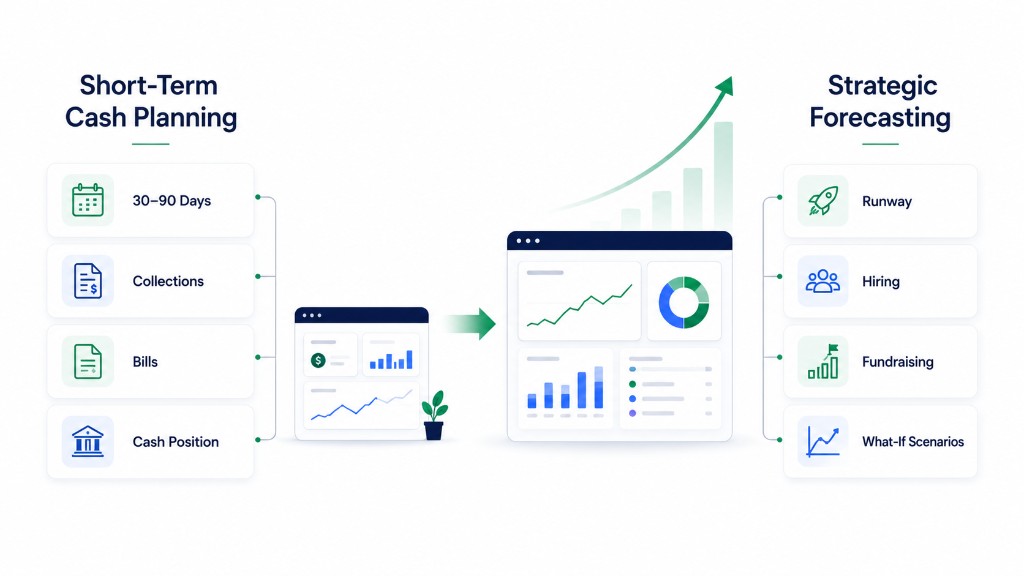
CCC tells you how efficiently working capital moves. A cash flow forecast tells you whether you will have enough money to meet future obligations.
For startup operators, you need both.
How does CCC affect startup runway?
CCC affects how much cash the business needs to support its operating plan, which can indirectly affect runway.
Suppose a startup has $500,000 in cash and expects to grow rapidly over the next year.
If customer collections slow while vendor payments remain unchanged, more cash becomes trapped in accounts receivable. The company may then need to fund that working capital gap from its existing bank balance. That can shorten runway.
This is why runway should not be modeled only from a simple monthly burn average. A forecast should also account for when cash actually moves.
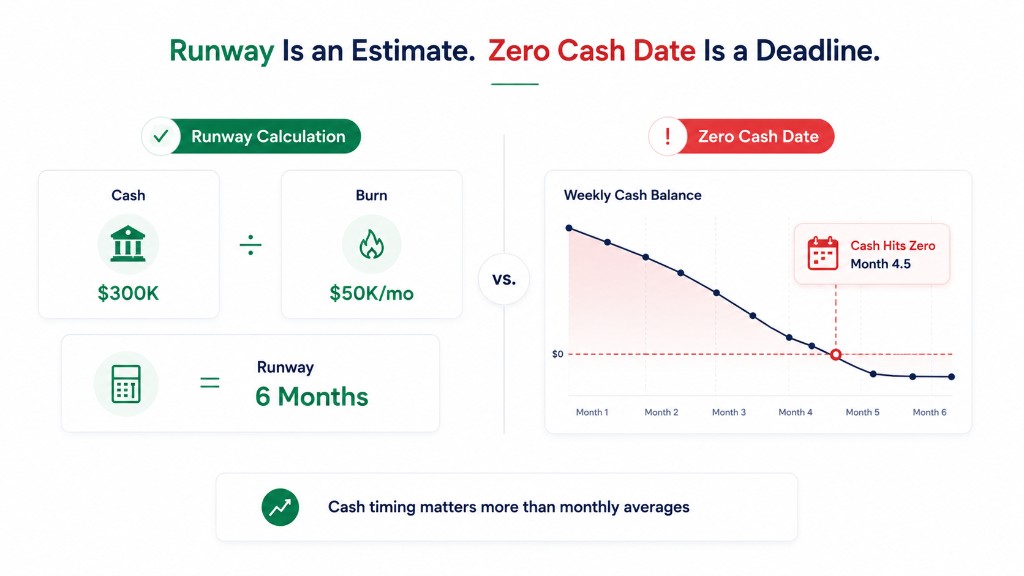
You can estimate your current runway with the free runway calculator, then use a detailed cash flow forecast to understand the timing behind the number. For why monthly runway can hide the real cliff, see zero cash date for founders.
What is a good cash conversion cycle for a SaaS company?
There is no universal "good" CCC for SaaS because SaaS businesses usually have little or no inventory and often have billing models that differ substantially from product businesses.
For a SaaS company, DSO and customer prepayment behavior are usually more relevant than DIO.
An annual contract paid upfront can bring cash into the company before the service is delivered. A monthly contract with Net 60 terms creates a very different cash profile.
This is why founders should avoid comparing CCC mechanically across different business models. Instead, compare your metrics over time and against companies with similar operating models.
How should founders use CCC in a cash flow forecast?
CCC is most useful when it becomes an operating management tool rather than a quarterly reporting metric.
Start with the historical numbers. Then ask:
- Is DSO increasing?
- Is inventory building faster than revenue?
- Are supplier terms changing?
- Is growth consuming more working capital?
- What happens if collections are 15 days slower?
- How much additional cash would that require?
This connects accounting metrics to actual cash planning.
For example:
- Current DSO = 40 days
- Scenario DSO = 55 days
- Increase = 15 days
That 15-day change can represent a substantial amount of additional accounts receivable as revenue scales. The exact cash impact depends on sales volume and payment patterns, so the best approach is to model it directly in the forecast.
In Zensus, founders can run scenarios in plain English (for example, what if collections slip 15 days?) and drill from monthly to weekly to daily cash timing on the features page.
How does CCC fit into a 13-week cash flow forecast?
A 13-week cash flow forecast shows when cash is expected to enter and leave the bank. CCC explains why working capital is creating a gap between those movements.
The two work well together.
| Forecast driver | Cash flow impact |
|---|---|
| DSO increases | Customer cash arrives later |
| DIO increases | More cash remains tied up in inventory |
| DPO decreases | Supplier cash leaves earlier |
| DSO decreases | Customer cash arrives sooner |
| DPO increases | Supplier cash leaves later |
If your cash forecast suddenly deteriorates, CCC can help identify the operational reason.
For a deeper operating model, see the 13-week cash flow forecasting guide. If payroll timing is your immediate concern, see Will I Make Payroll?
Worked example: how changing DSO changes cash needs
Consider a B2B company generating:
- Annual sales = $3,650,000
- Approximately $10,000 per day
Now compare two collection scenarios.
Scenario A: 30-day DSO
$10,000 × 30 = $300,000
Approximately $300,000 of sales would be represented by 30 days of receivables at this simplified run rate.
Scenario B: 60-day DSO
$10,000 × 60 = $600,000
The difference is:
$600,000 − $300,000 = $300,000
So a 30-day increase in collection timing can create a $300,000 working capital requirement at this illustrative sales rate.
This is not an industry benchmark. It is a simplified example showing why collections can have a direct impact on cash requirements.
Revenue can look unchanged while the bank balance moves significantly.
What should founders monitor alongside CCC?
CCC is only one part of the cash picture.
A useful founder dashboard can include:
- Cash balance
- Weekly net cash flow
- Runway
- Zero cash date
- DSO
- DIO
- DPO
- Accounts receivable aging
- Accounts payable aging
- Customer collections
- Upcoming large payments
The goal is to connect operational drivers to cash.
If DSO rises, your forecast should reflect later collections. If DPO falls, your forecast should reflect earlier payments. If inventory rises, your forecast should reflect the additional cash tied up in stock.
That connection is what turns a finance metric into a planning tool. Zensus connects bank data via Plaid, accounting via QuickBooks, and pipeline or subscription timing via HubSpot, then surfaces cash-floor risk with Slack alerts.
When should a startup pay attention to the cash conversion cycle?
Start paying attention when working capital can materially affect cash.
That usually happens when you have:
- physical inventory
- B2B payment terms
- significant accounts receivable
- large supplier balances
- rapid growth
- long implementation cycles
- large upfront procurement costs
For an early SaaS startup that collects annual subscriptions upfront and carries almost no inventory, CCC may not be the most important operating metric.
For a hardware startup growing rapidly on Net 60 customer terms, it can become critical.
The metric should follow the business model.
Related cash flow guides
- 13-Week Cash Flow Forecast
- Will I Make Payroll?
- ARR vs Cash Flow
- Runway vs Burn Rate
- Zero Cash Date for Founders
- Free Runway Calculator
- Free Cash Flow Forecast XLSX Template
Conclusion
The cash conversion cycle answers a simple but important question: how long does our cash stay tied up in the business before it comes back?
The formula is straightforward:
CCC = DIO + DSO − DPO
But the real value comes from understanding the three numbers underneath it.
Read the components:
- If DSO is rising, customers are taking longer to pay.
- If DIO is rising, more cash is sitting in inventory.
- If DPO is falling, cash is leaving the business sooner.
For founders, the most useful next step is to connect these operating metrics to a forward-looking cash forecast. A strong forecast shows not just how much cash you have today, but when customer payments and business expenses are expected to move through the bank.
Start with the runway calculator, then build a weekly cash view as the business becomes more complex. If you prefer a spreadsheet, use the free cash flow forecast XLSX template.
CCC tells you where working capital is getting stuck. Cash flow forecasting tells you what that means for the cash you will actually have available.