Yes, QuickBooks can forecast cash flow, but only within a specific scope.
QuickBooks Cash Flow Planner helps businesses project expected cash inflows and outflows over the next 30 to 90 days using data already stored inside QuickBooks. It combines connected bank account activity, unpaid invoices, unpaid bills, future-dated transactions, and manually added planning items to estimate future cash positions.
For many small businesses, that is enough.
For venture-backed startups, SaaS companies, and businesses managing runway, hiring plans, fundraising timelines, or multiple financial scenarios, the limitations become more apparent.
This guide explains exactly what QuickBooks cash flow forecasting does, what it does not do, and how to determine whether QuickBooks Cash Flow Planner is sufficient for your business.
We will cover:
- what QuickBooks Cash Flow Planner is and how it works
- the QuickBooks forecasting horizon (30 to 90 days)
- how QuickBooks unpaid invoices cash flow assumptions affect accuracy
- QuickBooks multi-currency cash flow limitations
- QuickBooks vs cash flow forecasting software built for startups
- when to move beyond accounting-only forecasts
What Is QuickBooks Cash Flow Planner?
QuickBooks Cash Flow Planner is a built-in forecasting tool that estimates future cash inflows and outflows using data already stored inside QuickBooks.
The planner uses:
- connected bank account activity
- unpaid invoices
- unpaid bills
- future due dates stored in QuickBooks
- predictions generated by QuickBooks
- manual planning entries added by users
According to Intuit, the planner is designed to help businesses understand expected cash movement over the next one to three months.
For many owner-operated businesses, this provides a useful short-term view of cash.
Does QuickBooks Do Cash Flow Forecasting?
Yes. But it is important to understand the type of forecasting QuickBooks provides.
Quick answer:
QuickBooks forecasts expected cash movement over the next 30 to 90 days using existing accounting and banking data.
It is primarily designed for:
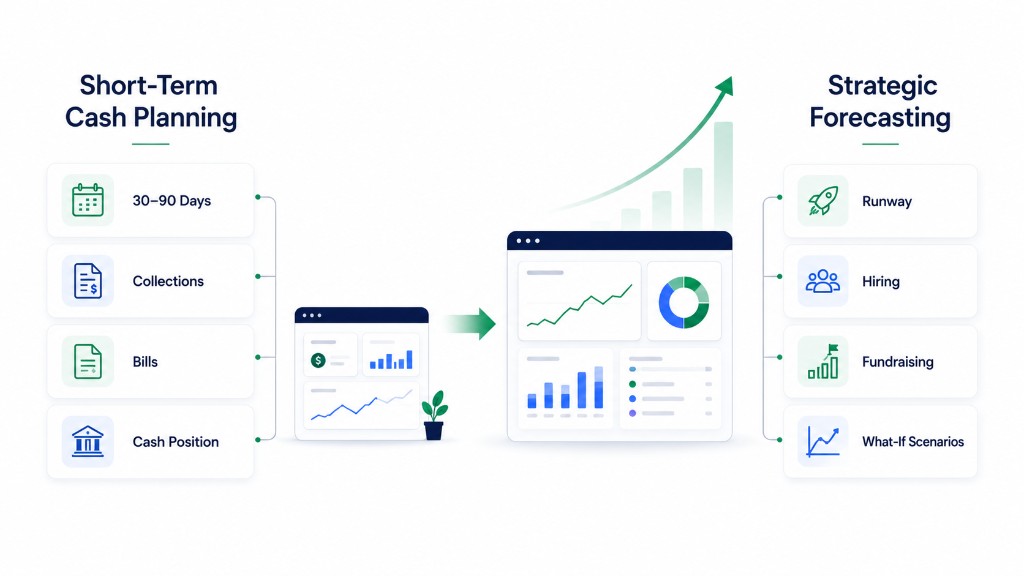
- short-term planning
- managing upcoming bills
- tracking expected collections
- understanding near-term cash availability
It is not designed to function as a complete startup financial planning platform.
Most founders asking about:
- runway forecasting
- fundraising planning
- hiring scenario modeling
- board reporting
- annual cash projections
typically need forecasting beyond the Cash Flow Planner's intended scope. For the broader framework, see our guide on cash flow forecasting.
How Does QuickBooks Cash Flow Planner Work?
The planner combines historical and future-looking information.
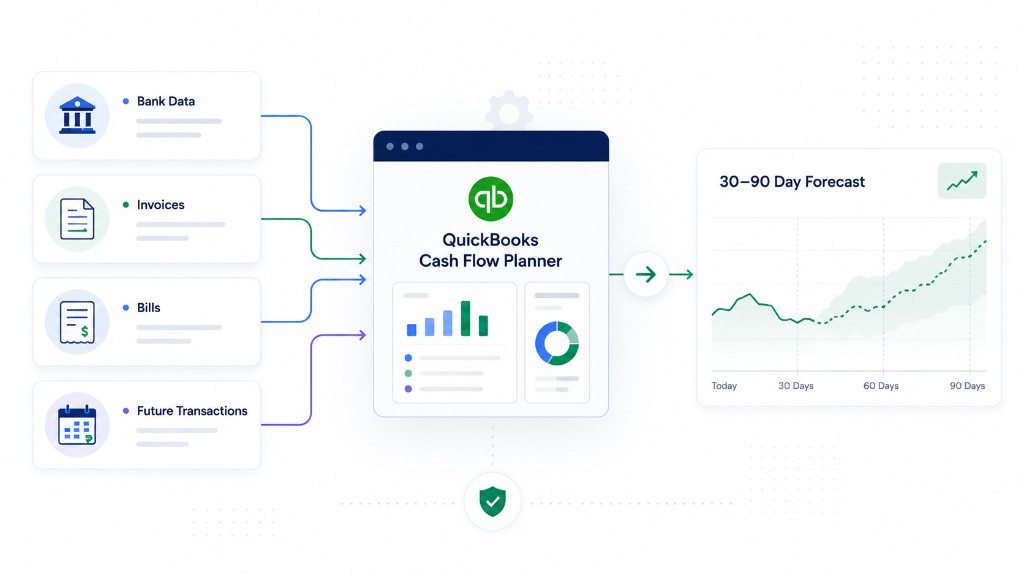
Inputs used by QuickBooks:
According to Intuit documentation, future cash flow calculations can include:
| Data Source | Included |
|---|---|
| Connected bank activity | Yes |
| Unpaid invoices | Yes |
| Unpaid bills | Yes |
| Future due dates | Yes |
| Planner events entered manually | Yes |
| QuickBooks predictions | Yes |
The result is a rolling forecast that updates as your books change.
For example:
- new invoice created
- vendor bill entered
- payment collected
- expense paid
The forecast updates automatically.
What Is the Forecasting Horizon in QuickBooks?
QuickBooks Cash Flow Planner is primarily built around a 30- to 90-day forecasting window.
Definition
Forecast horizon refers to how far into the future a forecast projects.
QuickBooks explicitly describes Cash Flow Planner as helping users understand cash flow over the next one to three months.
For many businesses, this is practical because:
- payroll occurs monthly
- bills are paid within weeks
- collections happen relatively quickly
However, startup planning often requires much longer visibility. Founders frequently need answers to questions such as:
- how long is our runway?
- when do we need to raise?
- can we afford three new hires?
- what happens if revenue grows 20% slower?
Those decisions often require six, twelve, or even eighteen months of forecasting. A 13-week cash flow forecast is the standard next step for weekly liquidity reviews; many boards expect even longer rolling views.
What Data Does QuickBooks Use for Future Cash Flow?
QuickBooks relies heavily on transactions and due dates already present in your accounting system.
A cash flow forecast is only as accurate as the assumptions and inputs behind it.
QuickBooks uses:
- open invoices
- open bills
- connected banking data
- scheduled obligations
- planner entries
This approach is convenient because setup is minimal. However, it also creates limitations when future cash events are not yet represented inside QuickBooks.
Examples include:
- planned fundraising rounds
- future hiring plans
- future software contracts
- revenue growth assumptions
- sales pipeline forecasts
If the data is not in QuickBooks, the planner generally cannot forecast it automatically.
Does QuickBooks Count Unpaid Invoices in Cash Flow Forecasts?
Yes. Intuit states that future cash flow calculations can include unpaid invoices that are due in the future.
Why This Matters
An invoice is not cash. An invoice is a request for payment.
Consider this example.
Example: $120,000 Annual Contract
A startup signs a customer on January 1.
Contract details:
- contract value: $120,000 annually
- invoice issued: $120,000
- payment terms: Net 60
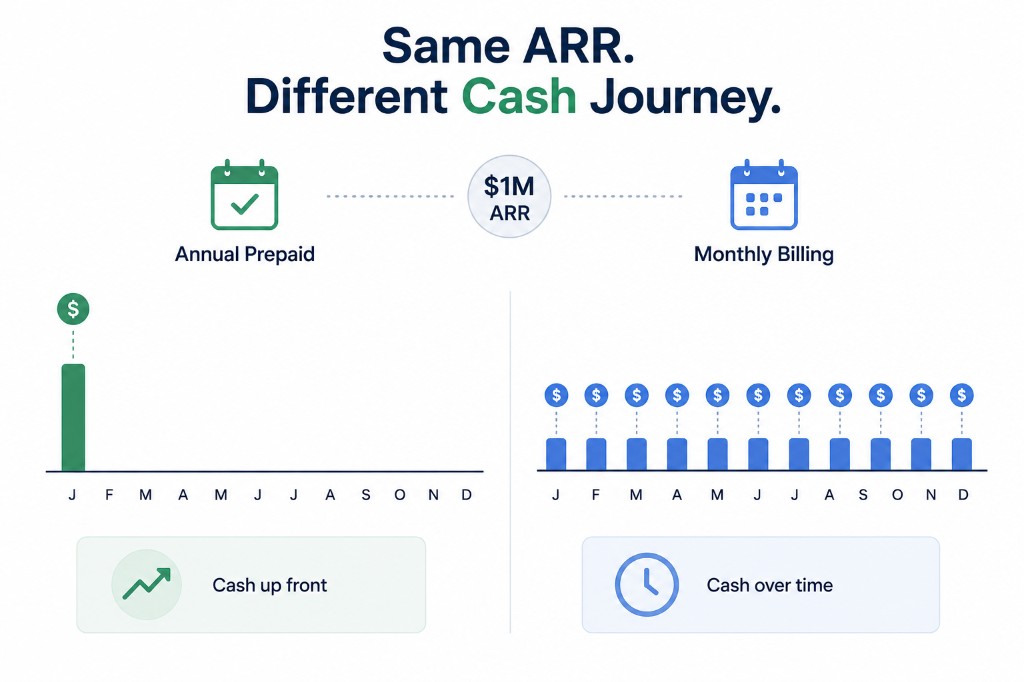
The forecast may assume collection based on the invoice due date. But reality may look different. For why ARR and bank balance diverge on prepaid contracts, see ARR vs cash for founders.
| Month | Forecast Assumption | Actual Cash |
|---|---|---|
| January | Expected payment | $0 |
| February | Expected payment | $0 |
| March | Customer pays late | $120,000 |
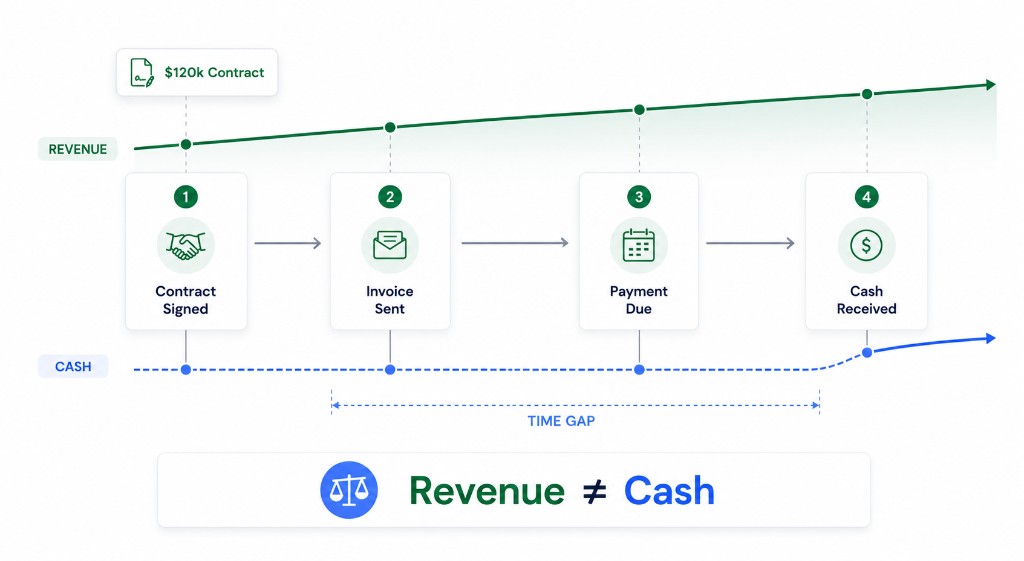
If collections slip, forecast accuracy decreases. This is not unique to QuickBooks. Every forecasting system must make assumptions. The important point is understanding what assumptions are being made.
Can QuickBooks Handle Multi-Currency Cash Flow Forecasting?
Not through Cash Flow Planner.
According to Intuit documentation:
The cash flow planner isn't available if Multicurrency is on.
Intuit also states that multicurrency transactions are excluded from cash flow calculations.
Why This Matters
Many startups today operate internationally.
Examples include:
- US customers paying in USD
- European customers paying in EUR
- contractors paid in INR
- vendors paid in GBP
Once multiple currencies enter the picture, cash forecasting becomes more complex. You need visibility into exchange rate exposure, currency-specific balances, and cross-border cash movement. Cash Flow Planner is not designed for that use case.
What Does QuickBooks Cash Flow Planner Not Include?
According to Intuit documentation, cash flow calculations do not include certain transaction types.
Examples include:
- multicurrency transactions
- journal entries
- some manually entered transactions
- certain disconnected account activity
Why Founders Should Care
Founders often manage important cash events outside day-to-day bookkeeping.
Examples:
- venture debt
- SAFE financing
- equity raises
- future hiring plans
- planned office expansion
- strategic acquisitions
These decisions may not exist as accounting transactions yet. As a result, they are difficult to incorporate into operational forecasts using accounting data alone.
When Is QuickBooks Cash Flow Planner Enough?
For many businesses, Cash Flow Planner is genuinely useful.
It works particularly well when:
- operations are relatively stable
- forecasts are short term
- revenue is predictable
- collections are consistent
- single-currency accounting is used
Typical good fit:
- local service businesses
- agencies
- professional firms
- small ecommerce businesses
- early-stage companies managing monthly operations
For these businesses, a 90-day view often covers the most important decisions.
When Do Startups Outgrow QuickBooks Cash Flow Forecasting?
Most startups outgrow Cash Flow Planner when they begin making decisions based on future scenarios instead of historical accounting data.
Common Signals
You Need Runway Forecasting
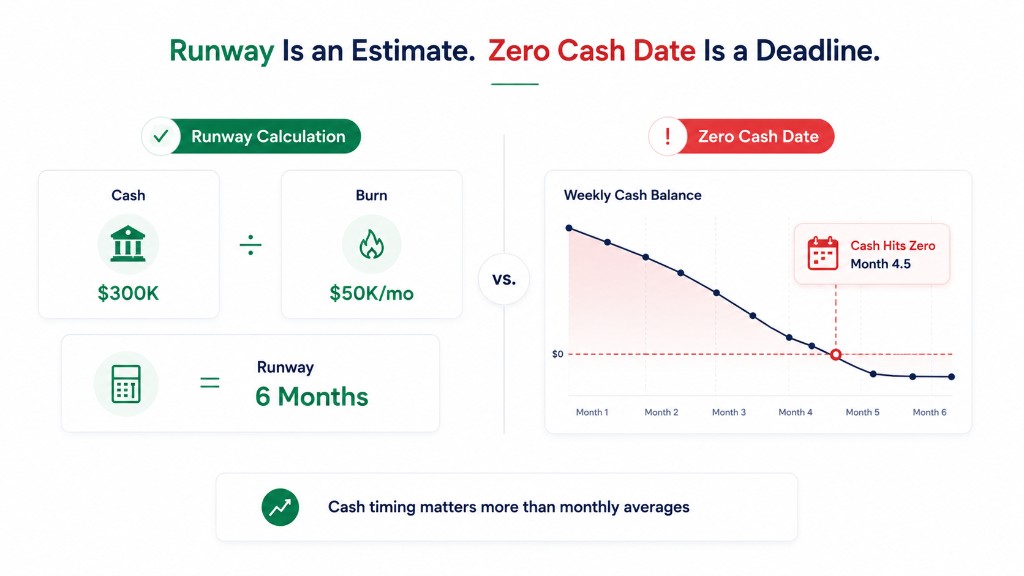
Runway is calculated by dividing available cash by monthly net burn.
Formula: Runway = Cash on Hand ÷ Monthly Net Burn
Founders rarely need only a 90-day view. They need to know cash position six months from now, twelve months from now, and fundraising deadlines.
A dedicated runway calculator becomes more useful at this stage. For burn vocabulary and 2026 benchmarks, see runway vs burn rate.
You Need Scenario Planning
Examples:
- what if revenue grows 30% slower?
- what if hiring happens two months earlier?
- what if fundraising closes late?
These are strategic planning questions rather than bookkeeping questions.
You Need Board-Level Forecasting
Investors often expect monthly forecast updates, burn analysis, runway tracking, and scenario models. Accounting forecasts and board forecasts are not always the same thing.
What Should Founders Use Alongside QuickBooks?
QuickBooks remains an excellent accounting system. Many companies continue using it even after implementing dedicated forecasting tools.
A common setup looks like:
| System | Purpose |
|---|---|
| QuickBooks | Accounting |
| Banking Platform | Cash management |
| Forecasting Platform | Planning |
| Runway Tool | Capital planning |
In this model:
- QuickBooks remains the source of truth
- forecasting systems build on accounting data
- leadership teams model future scenarios
This is where integrations become important. Platforms like Zensus connect to QuickBooks and extend forecasting beyond historical accounting records by modeling collections, runway, hiring plans, and multiple future scenarios in a single view.
Learn more through the QuickBooks integration page, our guide on cash flow forecasting, and the runway calculator.
QuickBooks vs Dedicated Cash Flow Forecasting Software
| Capability | QuickBooks Cash Flow Planner | Dedicated Forecasting Platforms |
|---|---|---|
| Short-term forecasting | Yes | Yes |
| 30-90 day visibility | Yes | Yes |
| Long-term forecasting | Limited | Yes |
| Runway tracking | Limited | Yes |
| Scenario planning | Basic | Advanced |
| Hiring models | No | Yes |
| Fundraising planning | No | Yes |
| Board reporting | Limited | Yes |
| Multi-currency forecasting | Not available in Cash Flow Planner | Often supported |
Based on current Intuit documentation, QuickBooks is strongest as an operational forecasting tool rather than a strategic planning platform.
How Zensus Extends QuickBooks for Founders
Zensus is not a replacement for QuickBooks. It is a planning layer that reads accounting data and models what happens next.
At Zensus, founders connect bank accounts via Plaid, accounting via QuickBooks, and subscription revenue via HubSpot into a single financial model. See how it works for the connect-to-forecast flow.
Where Cash Flow Planner stops at roughly 90 days, Zensus helps founders answer:
- when will cash run out?
- can we afford the next hire?
- what if a large customer pays late?
- how does an annual contract change runway?
- will we make payroll next month?
Founders can drill from monthly to weekly to daily cash flow, run scenarios in plain English, and get Slack alerts when a 30-day projection crosses a cash floor they set. Map pay-cycle risk with the payroll calendar calculator.
How Zensus handles your financial data is documented on the security page. Plans are on the pricing page.
Accounting vs Forecasting
Accounting records what happened. Forecasting estimates what may happen in the future.
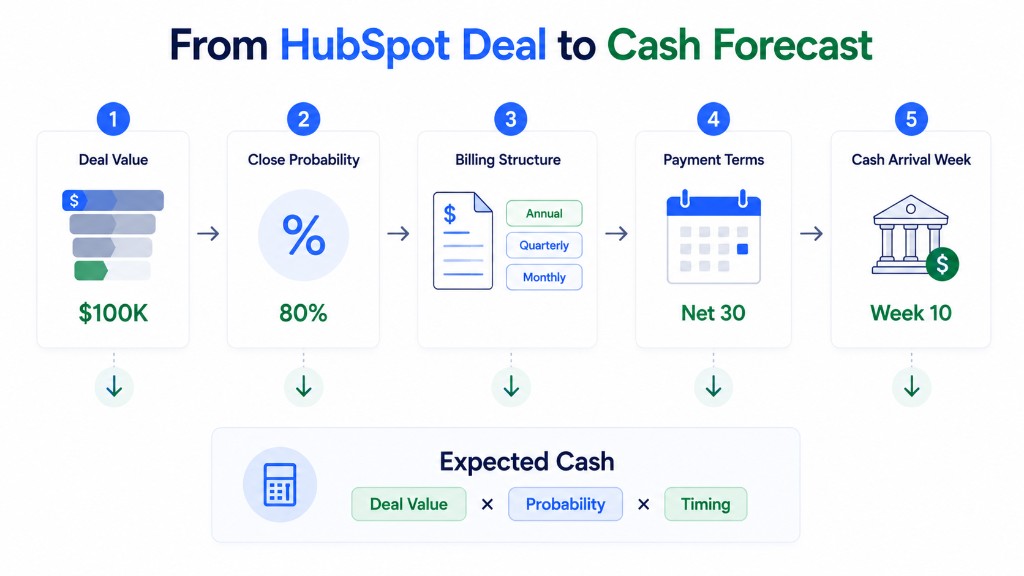
QuickBooks Cash Flow Planner sits between the two: it projects near-term cash using data already in your books. That is valuable for operational liquidity. It is not the same as a startup planning model that layers hiring, fundraising, pipeline, and scenario assumptions on top of accounting truth. For converting HubSpot pipeline to bank balance timing, see HubSpot pipeline to cash forecast.
The most effective founders do not choose between accounting and forecasting. They use both.
Final Thoughts
QuickBooks can absolutely help forecast cash flow.
For many businesses, Cash Flow Planner provides a useful view of expected cash movement over the next 30 to 90 days. It uses existing accounting data, connected banking activity, unpaid invoices, unpaid bills, and future-dated obligations to estimate where cash is heading.
The key is understanding what problem it was built to solve.
If your goal is managing near-term liquidity, paying bills on time, and understanding expected collections, Cash Flow Planner can be extremely helpful.
If your goal is managing startup runway, fundraising timelines, hiring plans, board reporting, or multiple future scenarios, you may eventually need forecasting tools that extend beyond accounting data.
Accounting explains where cash has been. Forecasting helps determine where it is going next.